Sunday, 10 July 2016

Down the River...


Right, well I haven't got round to sorting all the in-depth stuff on Jabberwock due to general business and work, so in the meantime, a mini-project which evolved in about 48 hours.

Cupola Contemporary Art in Sheffield (with whom I've shown work a number of times in the last few years) announced an open call exhibition, but at somewhat short notice, based off the quote "The Beautiful is Always Bizarre".  After an evening of going through lots of books for inspiration, I stumbled on some pics in a compilation book from Joel Sternfield's "Walk the High Line", an excellent photo-essay of a (then) abandoned elevated freight railway in New York which is now a public park, but which at the time was a rather tranquil overgrown railway line running between skyscrapers.  Look it up, the pics are great, and if you can find the expensive out-of-print book with all the images, I'd be very jealous.
  I liked the contrast between the 'beauty' of nature and the severe buildings, and wondered if I could do something on a similar theme in miniature.  After trying ideas like building models of brutalist architectural designs and shooting forced-perspective shots in rural locations, I decided to do instead miniature riverscapes which could be shot against industrial and suburban settings.

However I wasn't convinced if it was right for the call or not, so reckoned I ought to knock-up a quick trial piece to test the concept.  This being Friday afternoon, and with a deadline of Sunday evening to hit, it damned well would have to be quick.


Happily I work in the DT department of a large secondary school, so there was plenty of scrap material to choose from, and being as I was stuck at work for an hour after the end of my shift, not being paid whilst I waited for a lift, I thought I'd get started on it.  So a large piece of scrap wood was salvaged from the bin, some tatty mirrored card, and some packing foam, and a rough winding shape of a river was cut. 


The packing material was hacked with a saw then glue-gunned down.  I then made up a bucket of filler using PVA glue and sawdust, ready for the next stage...


Back home that evening, and the contours were smoothed out a bit with plaster bandage, which didn't work too well, given it was quite old, so the filler went on next.


The rushed nature of it meant the bandage hadn't dried particularly well which rather affected the drying of the filler.


By the careful application of a hair-drier, the process was sped up, then out came the acrylic paints.  Now it was time to leave it to dry overnight. 


Saturday, out came the modelling flock and PVA for a very quick application to give it a bit of texture.


With rain forecast for Sunday, and an unwillingness to hang about too long in urban and industrial areas, it was quickly out to Keighley to find somewhere suitably oppressive and built-up.  You'd think Keighley would have this in spades, but it turns out it only feels like a post-apocalyptic dystopia, actually when you start looking, everywhere has tons of greenery...


A suitable industrial road was found, free of drug dealers or ne'erdowells, and out came the set...


The trees were a late addition, and borrowed from my brother-in-laws dismantled scalextric set (without his knowledge, so technically borrowed should read stolen I suppose).  A lack of glue and an excess of breeze meant they were tilting at a rakish angle, but there wasn't time to fix that.  In any case this was just meant to be test to look at the general concept.


Also, the breeze kept blowing the excess flock and things onto the 'water' too, which was a little annoying.

So shoot done, and I realised it was actually a weaker idea for this brief than the 'backup idea', a hopefully tantalising glimpse of which is shown below, and more of which in a later post.

I might still return to the river concept and do it properly, and its a little annoying after such a rush to get the rough test piece done, but better to realise that now than the night before the exhibition...


Hopefully some posts on that blasted Jabberwock next...


Saturday, 13 February 2016

The golden age of the train set?


First blog of the new year, and a welcome to any new readers. I've not posted much lately, but only because I've been amassing a large amount of work for a project linked to Alice in Wonderland, but I'm not quite ready to put anything up yet.  So being as shortly this blog is going to get extremely busy with updates on "Project:Alice", until that’s quite ready to be posted, instead there will be a few bits of misc.
This week will feature something of an impulse purchase, and a horrifyingly in-depth review of a train set. I am, by nature, a bit of a hoarder, something of an issue when I live in a small house, and a very definite issue when I live in a small house which now contains three foster children. But I do have a bit of a habit of buying and in a sense collecting items which might one day come in useful, hoarded against the day when I have time, money, or space to do anything with them.
Which brings me neatly onto this purchase. I went for a walk with the family and an old mate along the Severn Valley during the Christmas hols, a walk which featured Hampton Loade Station as its halfway point so we could grab a hot drink. And as at many preserved stations, there were fundraising activities being run by the heritage groups. I like to look in these places because they tend to contain old models, toys, and books which get missed by the more ‘mainstream’ shops. I also these days have to fight hard against the urge to buy things; not because I don’t like supporting these causes, I really do, but because of my earlier point about having a small house (not to mention a smaller income).
 
What they had on a table outside though, was an 0 gauge train set. Old, but not old enough to be overpriced collectible stuff, it had an unusual plastic locomotive, battered box, oval of track, and two nice metal carriages. I glanced at it, went back to it a couple of times, realised I couldn’t carry it back along the three miles in its tattered box, and forced myself to ignore it, whilst all the time thinking it would be a perfect parts donor for "Project:Alice".
I spent the evening looking the set up on Ebay, unable to quite ignore it, then the next day decided I did indeed want it after all, and engineered an afternoon trip to Bridgenorth via Hampton Loade. To my immense disappointment, the shop was closed. However, I managed to collar a passing volunteer, who was only too happy to oblige, and thus for a ridiculously small amount of money, I was the owner of this vintage train set, ready to be broken up for parts.
…except it won’t be. Because like the immature so-and-so I am, I got the set out of its box when I got home, and decided it was really quite wonderful.
 
Lets take a look at the box lid first. That painted illustration is beautiful; I far prefer stuff like this to modern photographed models, which I’ll admit is somewhat ironic for someone who spends most of his time photographing miniature sculptures and models. There’s just so much going on in the painting, and if the details aren’t all 100 per cent accurate, then who cares? It taps into a rich vein of nostalgia for me, when I was little some of the model train catalogues, not to mention a lot of the books I had, featured paintings on the covers (my favourite being a very old Wrenn catalogue which I’ve kept, which has a very moody, atmospheric picture on the cover). I also just love the comment about "Electric Shock-Proof"… ahhh, the Golden Age of Children's Toys.
 
 
And so to the contents. Boring stuff first, the track is classic tin-plate train set fare, simple but quite sturdy, not much in the way of damage or corrosion. According to my research this set was a sort of transitional one between Mettoy making full tinplate train sets, and their later embracing of simpler, plastic sets (as Mettoy-Playcraft). I actually had a Playcraft train set as a child, a simple push-along set with flexible red plastic track, without realising until now it was by the same manufacturer. Another link to my work is that the later Playcraft Clockwork HO gauge tank loco, produced in assoc. with Joueff (the French model railway manufacturer) is the loco which I used as the basis for the goods engine in the Britannia Steampunk Monorail build.


The passenger carriages next- these are simple, crude, representations of Pullman carriages. And they are brilliant, just because in these days of super-detailed, super-realistic models, I find something much more appealing in these older, less detailed and incredibly unrealistic but very charming toys. Judging from what I’ve found online, these are hangovers from the old all-tinplate range. It probably would have cost too much to tool-up new plastic coaches and stock to go with the locomotive.
 
And that brings me onto the locomotive itself. Usually, with these older O gauge trains, the prototypes date from the golden age of the toy train, the early 1900’s, and are thus loosely inspired by the colourful express engines of the LMS, the Southern, the GWR and the LNER. What really attracted me to this set is the prototype, which is the BR Standard ‘Britannia’ class loco, "Robin Hood".
 
A quick word on the prototype, which has relevance; the Standard Classes of locomotive were commissioned by British Railways to capitalise on the large stocks of coal under Britain, and to replace life-expired older locomotives after the war. They were designed with greater efficiencies in mind, incorporating the best features of older locomotives and more modern mechanical aspects seen on some of the American locomotives (high running-plates, etc.) which had been run on British tracks during the war. In a way, the Standard Classes never achieved their potential, being replaced by diesel and electric trains, some working only a fraction of their intended lifespan (its quite an intriguing notion that some, such as the 9F heavy freight class, could legitimately have been running into the mid-80’s). The "Britannia" class of locomotives were built in the first half of the 1950's, with the prototype of this toy, the "Robin Hood" entering service in 1953 and surviving until 1967.
 
It is unusual then to have a locomotive from this timeframe thus represented as the subject for this sort of train set.  By this time, a greater move was being made towards somewhat more realistic train sets in 00 gauge (the likes of Hornby Dublo, Triang/Rovex and so on capitalising on a desire for more realistic trains on smaller tracks, better for the modern home).  This must then be one of the last designs of the purely toy, O gauge sets ever done, mixing the traditional toy train set with more modern plastic materials.
 
The locomotive itself is battery powered, on a 4-wheeled chassis, with moving front pony-truck and fixed rear pony truck.  The bodywork is in black plastic, but the mechanism is mostly metalwork.  The 4-wheeled tender is all-plastic.  Back when this set was produced, there was less knowledge around plastics, and thus a lot of plastic toys were moulded in material which hasn't stood the test of time, and which has warped heavily and deformed with age; I own some old OO carriages from this period which are so warped they wont even sit on the track.  There is some evidence of the plastic deforming, particularly on the tender, and a bit on the loco boiler too. 
 
 
An interesting detail- the tender has the coat of arms on it, and correctly feature the lion facing forward on each side (as per the prototypes, which were found to be in breach of their licence from the people who granted heraldry rights as it was classed as being technically two separate heraldic designs).


But look at that bodywork- the moulded detail, including the number plates, is very crisp, and though it is a very basic toy like affair, it really does capture the atmosphere of the prototype. I also wonder if there is some reasoning behind the use of black plastic- was it more stable perhaps than using the more realistic green (the main livery these locomotives ran in)? The lack of painted details is interesting, suggesting a toy designed to be cheap to produce and sell, which also hints that the more decorative tinplate carriages are indeed leftovers from older tinplate sets.
 
 
A word on the loco wheels. These are of a somewhat unique type known as the ‘Boxpok’ wheel, which was created by the Chief Mechanical Engineer of the Southern Railway, Oliver Bulleid, and which featured extensively on his Southern Pacifics. Their inclusion on this toy then seems a bit odd, but slightly appropriate given that the design of the "Britannia" class was partly influenced by the Southern Pacifics. Interestingly some pictures of other examples of the "Robin Hood" toy online show it with normal spoked wheels, and the box art also prominently features a Streamlined Southern Pacific. I’ve seen a Mettoy example of the SR loco in tinplate, so was the idea that plastic toys of these two locomotive types should be produced, sharing a common chassis to save money? Or had they simply got a load of the older SR chassis in stock, which were used up on the earlier batches of "Robin Hood"? If a plastic version of the Southern Pacific exists it would be wonderful to acquire one, as they remain a favourite prototype locomotive of mine.
 
A shame though is that the locomotive has some damage, and appears to be missing some parts on the lower of the chassis- my guess would be this is the ‘stopping’ mechanism which would appear to be activated by the odd bit on the tinplate track. Having connected up some batteries and given the metal contacts a bit of a clean, and the mechanism a drop of oil, I was pleased to see the locomotive still works.
 
I know most of the ‘collectors’ end of the market is focused on tinplate O gauge trains, and that at the time this oddity was produced it must have really been something of a last throw of the dice in this scale. But there is something utterly wonderful about this set, from the box art to the characterful locomotive.
As an aside, wouldn’t it be nice if toy manufacturers could make stuff like this now? Back when Mettoy were making these, manufacturing in Britain meant British prototypes. It irks me slightly (at an age where I’m buying toys for the foster kids, not to mention ‘donor’ models for things like the Model Village Project) that ‘toy’ trains tend to all be generically American-inspired. Indeed the cheap battery-powered O gauge train sets which were so readily available in 2005, and which formed the bases for most of the locomotives in the model village, were somewhere between a Germanic and American loco in outline. Even these are hard to come by now though, ten years on. I do wonder if I should buy one just to keep as it is, but they are usefully, well-made toys which convert well into other models. I recognise that the cheap, mass-produced toy market is international now, but it would be pleasant to have a British-outline toy train, at least something other than the Mattel-interpretation of Thomas the Tank Engine...
 
So what to do with this train set then? The original intention was to break it down for parts, but it would seem pretty criminal to do that. On the other hand, I don’t have an O gauge layout on which to run it, and given my foster kids have been raised in the era of ‘utterly disposable cheap plastic crap toys’ I can’t see it surviving their use, despite how much we try and correct their behaviour. So that relegates this train to use in photography projects if I’m going to justify keeping it.
That’s not a bad thing of course; I have three railway related projects slated for 2016 which could happily feature this engine. Some restoration work is planned, and I’m tempted towards a bit of a repaint too, even if it will destroy any value it has. But I rather envisage this as one of those items hoarded against a future where I might be able to have an O gauge railway in the garden or loft, specifically for all the slightly odd railway-related sculpture pieces I’ve made over the years…


Sunday, 29 November 2015

Train Set versus Model Railway


Continuing the vague theme of 'train set vs. model railway', a little post on something I'd made last year.  With the Foster Childs moved in, surprisingly all three females combined an interest in both girly tat with mechanical items.  Particularly, eldest Child wanted a train set at Christmas.  So I decided to build something.  Small house, so needed to be small and self contained, relatively basic but with play value.

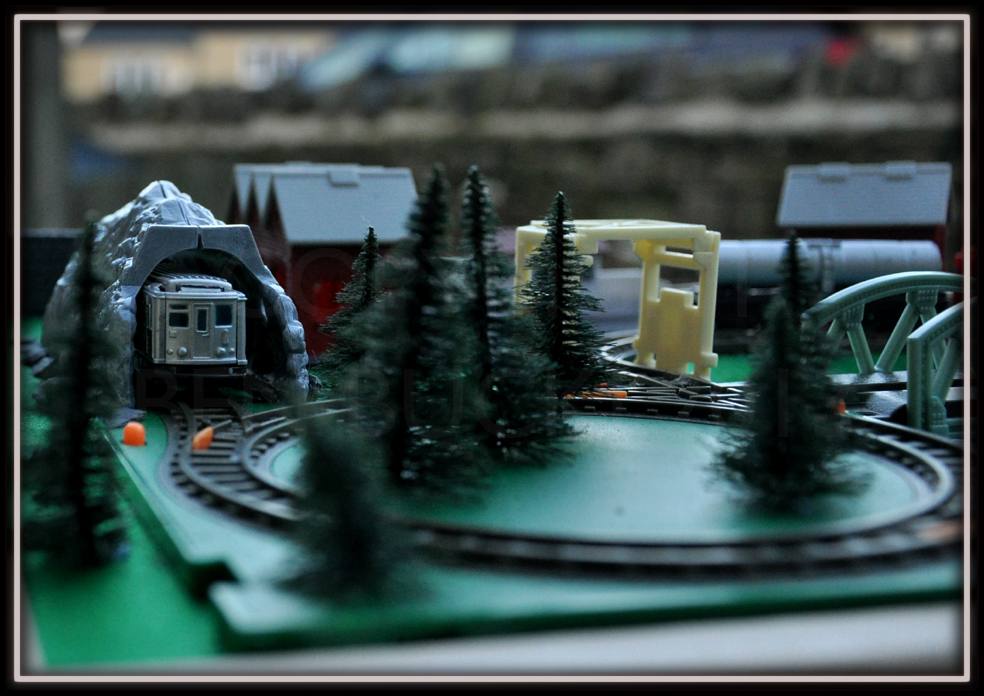
As a legacy from the Britannia Model Village I had a quantity of some now-not-produced items known as XTS Train Sets.  These were a marvelous, modular system of coarse-scale N gauge mini train layouts.  They were rather nice items which originated in America I believe, not too heavily imported into the UK but they turn up on Ebay from time to time.  With nothing else planned for them, I set about working out what to make.  As the above pic shows, with all the components (and a few more off Ebay) a somewhat sprawling layout was vaguely planned, but I decided to scale it down a bit.


I decided to mount it on an A3 noticeboard to save a bit of time (it had green felt which made a nice grass covering, and saved me having to build a baseboard, and could be hung on the wall for storage).  Bluntly, doing the old Self Assessment Tax Form delayed starting on the project, so it needed to be achieved quickly.


Trial-fit of components proved I'd need to do some hacking and sawing of the tracks to get things to fit, providing a suitably exciting layout.


Trackplan sorted out, and track modified to a more customised shape, it still looked a little bland and boring.  This wasn't exactly going to be the pinnacle of railway modelling, but I didn't want something so basic.


A nights work, and the above was the result.  The felt/card board was sliced through with a scalpel, a second sheet of tougher wooden board glued on underneath, and a passable representation of a river was created.  A road from black foam, and some toy buildings from an ancient, rather battered Thomas train set bought cheaply online, and a few trees from the model railway bits-box, all providing a bit more landscape.


Its not going to win prizes, and its not going to get the golden trophy at the Warley Show or anything, but it serves a purpose, hopefully to be a gateway to more model making (Eldest Child is quite practical at that sort of thing), but equally if she decides to just be interested in boyfriends, phones, and unicorns, it won't be too much time effort or money wasted making it.


It has quite good play value too, as demonstrated by the fact that (in time honoured fashion) the adults spent more time playing with it at Christmas than the Childs did.  Two trains can run at once, with the possibility of the inevitable collision adding a note of drama to proceedings.


It was well received, and has proved reasonably robust.  And to this year; Middle Child has gone straight onto the 'dolls, ponies and boys' route to growing up stereo-typically, but Youngest Child want a train set.  So something similar, a bit simpler, using some of the other XTS components is under construction in time for this Christmas.  More to follow...

[assuming this blog still has any regular readers, given its sporadic updating, apologies.  Couple of commissions and the Self Assessment have rather slowed down photography and model making of late, but I'm trying to get back into the swing of things.  A solution to the storage problems for built models should allow me to get making again, with a couple of big projects to complete, not to mention a ton of Airfix kits bought in last years Black Friday sale to build...]

Sunday, 8 November 2015

Playing Trains


Being as I'm bogged down with doing a big project at the moment, but unable to post info about it as its unfinished, I thought I'd put up some info on a little build I did last year.  A lot of my miniatures building tends to be based around doing prop builds for photography shoots.  And the big photography project I was involved with in 2013/14 was "The Home Is..." which basically was building a living room set, and photographing it in unusual locations (playing on themes of where people felt relaxed etc; there's more over on the Ribbon Photography blog anyway, here http://ribbonartandphotography.blogspot.co.uk )


One of the shoots we wanted to do was at a railway station, and with access to a location for a whole morning, we thought we'd experiment with some of the other room sets beyond the core 'living room' set, and that we'd try some 'hobby rooms' to capture the feeling of someone relaxing in a domestic environment, but with the set located outdoors.  Obviously a good place to start given the locale would be someone playing with a train set. 


Of course, a problem with mainly doing model building for photography is that I don't actually have a model railway to use, so decided I'd have to build one, as quickly as possible.  And preferably without spending anything.  So it was out with the old toy trains leftover from the Model Village build, some scrap wood, and a quickly sketched plan for a fairly complex and photogenic-looking railway based off my old childhood train set.  It was designed to fold-over for transportation, so not to take up too much space but to be big enough to show decently in the pics when unfolded and assembled on-location.


The problem was that it became a wee bit too complicated, and delays caused by prepping the house for the Foster Kids moving in meant there wasn't time to finish it, especially as it was basically going to be a one-use photography project.  So it was time to do something a bit more simple.


The actual build took a morning, come the finish; a derelict Ikea A1+ sized frame turned upside down with the plastic out of it and replaced with wooden sheet, some of my old model railway buildings, an oval of chunky plastic toy railway track, and a load of hanging-basket liner would have to suffice.


The above shows the slightly slip-shod build quality, but then a lot of the problem with the earlier build was that I should have realised I wasn't making an actual model railway, I was making a train set, furthermore it had to look just good enough for the picture, to appear in a single shot, not too large.


The actual 'look' of it is something I thought about for some time; there is a definite distinction between "Train Set" and "Model Railway", by which I mean a Model Railway tends to have months, years, lavished on it, a perfect replica of a landscape.  A Train Set tends to be more simplified, less scenery, definitely more emphasis on trains whizzing about in a circle than realistic operation.


After years in storage, the old buildings were in need of a bit of TLC, but were used for timescale purposes, but also with more than a hint of nostalgia of my old train set when I was little.


Also worth mentioning the train that mainly appeared in the shoot, an ancient Triang DMU which was my Dads.


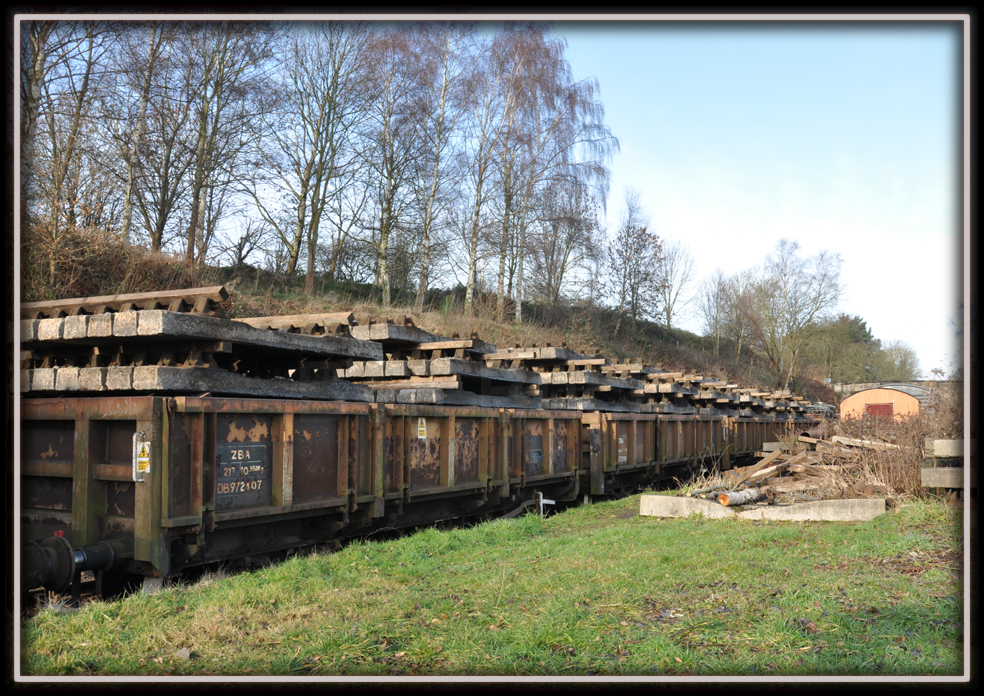
And so the background, a nice rake of engineers wagons...


...and the shoot, with a few other bits of set dressing quickly improvised for this test shot.


It...well, it looked alright in the photos, but we decided following the test shot and with time running out for the project, we decided to junk the 'hobby room' concept without further development.  But I wanted to use elements of the idea in another train shot, so it was back to the original plastic toy trains, and a plan for a mini-layout which could sit on the floor beside the living room set.  


Quick mock-up, but once again time constraints (with Foster Childs due to arrive imminently) saw it canned.


So to the final shot, and a rather more subtle approach...


...spot the train; in this case another little dose of nostalgia, and an ancient model kit of a 9F steam loco built by my late Uncle Verdun; nice to have it appear in the project.

So that was the total of the miniature builds in a project which took a great deal of a year; but as a future post will show, not the only excursion into 'Train Set vs Model Railway' territory...