Tuesday, 10 October 2017

Jabberwock Pt.10: Going Narrow-Minded...


Having decided that the crane-locomotive idea had some potential, I was struck by the fact that the size of the prototype would be a challenging issue...  The possible solution was to go narrow gauge.

Just to put that in context; in Britain, the standard width of railways is 4ft, 8 and a quarter inches, which is because that is how wide some primitive wagonways were, which in turn has to do with the width of chariot axles and horses-backsides if you go back far enough.  It's a bit more technical than that of course, other sources of information are available.

Narrow Gauge railways were developed mainly for industrial use, or for building railways in tricky terrain, and consequently locomotives and equipment tends to be smaller, at least in the UK.

Playing about with the idea, the narrow gauge locomotive I like the most is the England tank loco:


These early veterans, running on the Ffestiniog Railway in North Wales, are quite large for their scale, characterful, and powerful, but run on the narrow gauge that I'd need to consider for a final build...


"Prince" and "Palmerston" are still functional, seen in these pics I took a few years back; "Princess" and "Welsh Pony" are in store/under restoration respectively.


Traditional crane-tanks have their crane jibs above the boiler; due to the limited size of the loco, I'm improvising a fair bit here, and mounting the crane alongside the boiler in a distinctly non-prototypical fashion...


A benefit of choosing the England tank loco is that Ertl used to make a decent die-cast model based loosely on the design, for their Thomas the Tank Engine range.  Bought cheaply from a charity shop, and with a lot of work with a razor saw later had it down to its component parts.


More toys from the same source provided parts for the rest of the build, along with some broken kit parts.


Tarpaulins were scraps of felt.  I wasn't too bothered with the scale look of things, this was more of a concept test...


PRO
Well, the idea of doing a narrow gauge crane tank looked like it should have had some room for further experimentation and development.

CONS
You cannot really tell there is an England tank loco under all those gubbins, and using the toy digger parts made it all look too modern.  I reckoned it was worth exploring the concept further though...

Jabberwock Pt.9: Crane on the Train


A logical progression from the Train-tank was to go for the whole monster being rail-based.  Its not that far fetched, there were (and are a few surviving) locomotive-mounted cranes.  And in the context of Wonderland, there is a bit with Alice riding on a train in the world of the Looking Glass, so it would be feasible for there to be a railway in Wonderland on which this could run.


I liked the idea of a monster being on the railway, as it fitted in with all those Romanticist Victorian fears about what the train represented.  And there are some great ‘train monsters’ elsewhere in fiction, such as a wonderful illustration I saw of a demonic, somewhat anthropomorphic train in an old Victorian newspaper, and of course the mostly-cut “Nightmare Train” sequence in the film “Spiecies”, designed by the legendary artist HR Giger (where a train gobbles people up off the platform, in the planned -but never filmed- sequence). 


I did design it first this time, but the actual build was a little more improvised.  An unfortunate consequence of using the cheapo toy train as the basis is that it has come out looking a little too unlike a traditional British locomotive (finding a decently sized toy locomotive is tricky enough, and British prototypes all-but non-existent), but hey-ho, it shows the concept.


The bits and pieces are the usual haphazard assemblage of old model kit pieces, household junk, broken toys...


This is more of the sort of thing I ought to be aiming for, a proper veteran of a British tank locomotive, 1054, the Coal Tank, on the Keighley and Worth Valley Railway.


PROS
It is a more typical design, and perhaps more logical in context than the ‘tank’ version.  It could indeed exist in the world, and meets the basic criteria I set out.  It was somewhat top-heavy though, in trying to make a tall, intimidating dragon-like creature-machine...

CONS
The idea needed  working through a bit more, not least because trains are massive.  I could, however, imagine building something more to ‘narrow gauge’ sizing, as some narrow gauge locomotives can be quite compact.  Needed work anyway…

Jabberwock Pt.8: The Steam Landship


The logical development of the tank monster, this is closer to the ‘Steam Landship’ model I built for the earlier Steampunk project.  Some of the early sketches were revisited, as well as the model from that shoot.  


Which led to a newer sketch, trying the ideas out further.  Whilst the locomotive looks nicely Victorian, the caterpillar tracks on the above sketch are far too modern.


Again this was just something of a concept test, hence the simple forms used once again, the majority of the model being assembled from offcuts of wood.


The concept seemed to work very nicely, but the issue was the size of the thing, and also the steam-powered elements were perhaps not as obvious as I'd have liked, so some more development was in order...

Jabberwock Pt.7: The Landship.


The tank monster idea came out of reading books like “Band of Brigands” about the first tanks used in the First World War.  Though massively outside of the period which Looking Glass was set in, nevertheless there was something about the descriptions in "Band of Brigands" of surprise and shock with which the machines were greeted; not to mention something inhuman and relentless about them too, which seemed to fit with what I was doing.


In best Victorian sci-fi tradition though, it could be made to work- Caterpillar-tracked vehicles did exist, albeit in low numbers, in the period, and I’d made a steam powered example for the earlier Steampunk Project (inspired by the HG Wells story “The Land Ironclads”- see above).  I thought that something similar, on a smaller scale, might well work.


The basis of both the ‘normal’ tank and the more Jabberwock-like version were some blocks of wood, offcuts from work, which were shaped with saw and sanding belt, to resemble a First World War tank (or Landship, as they were known in the early days of their development).  Again, these models are quite crude and lashed together, but then this is all about exploring how a sketch might work in real life.


The design sketch...


With the little model built, something a bit bigger was knocked together by the same methods, again using offcuts of wood. It is definitely more 'inspired by' a WW1 tank/Landship than a scale model, but then I am really just wanting to test the concept at this stage...


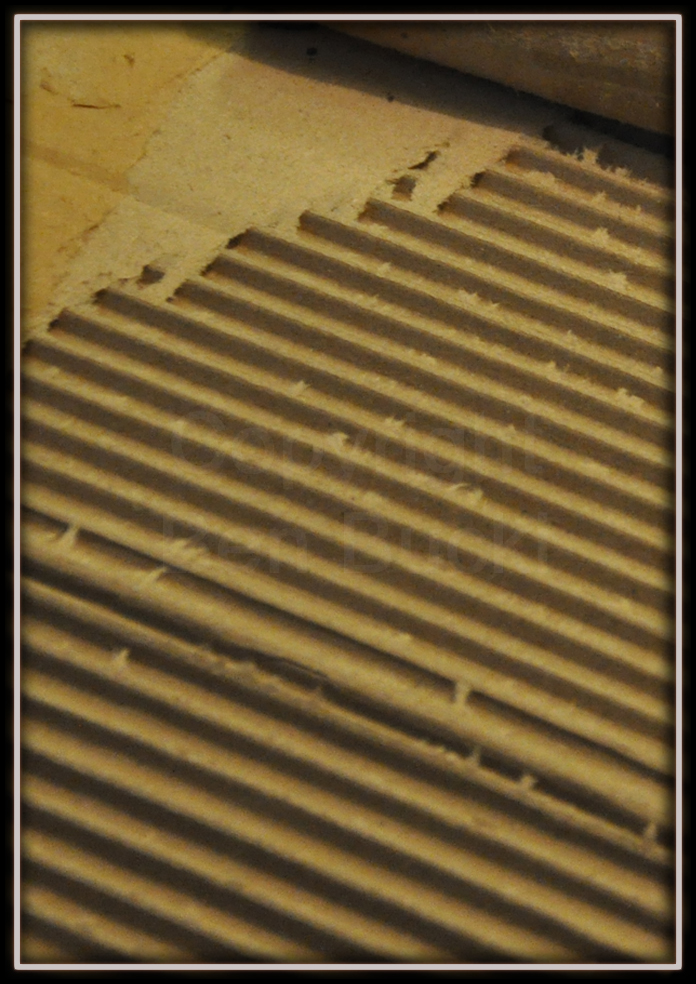
To represent caterpillar tracks on these test models, I turned to the same method used on the Iron Horse model, and dismantled some corrugated card, peeling off the outer layer to reveal the corrugations.


The usual mix of plastic kit odds and ends, and some material to represent tarpaulins (to look like ragged skin) were applied.


Painting was a mix of blacks and browns, sprayed on, with a very light dusting of boltgun metal to give an oily, metallic sheen.


A detail carried over from the sketches, the 'claws' being trees that have been inserted in the non-working sponson guns.


I was very happy with how the design worked out as an exploration of the idea, so I proceeded to move onto doing something similar but with steam power, instead of diesel...